Sound is often taken for granted in the art of film. Yet, even in the genre of silent films, music accompanies the visuals. Whether it is the dialogue between actors/actresses, the music, or the sound effects in the background, the choices made in sound design influence how an audience perceives a film.
Loudness, pitch, and timbre are fundamentals of sound and these principals of sound need to be taken into consideration to make use of audio appropriately in a film. Loudness relates to a sound’s amplitude; proper use of loudness helps the audience perceive distance within the film. Pitch is a certain frequency a sound makes; pitch is important to help the audience discern a sound. Timbre is simply how something sounds; most people can decipher the sound of a piano versus the sound of a violin or the sound of footsteps versus someone clapping their hands. Timbre creates texture and provides more realism in film by replicating how we recognize sound in real life situations.
Brown (2015) describes sound design in film as the use of foley effects (various sounds that complement the action seen, such as: gunshots, the sound of footsteps, etc…), atmospheric soundscapes, the music utilized, and the tastefulness of all these sounds combined (p. 95). Proper sound design in film almost creates an experiential realism for the viewer. Complementing a scene is the key; the sound, whether it is sound effects, the dialogue, or the music, should always work with the scene and not against it.
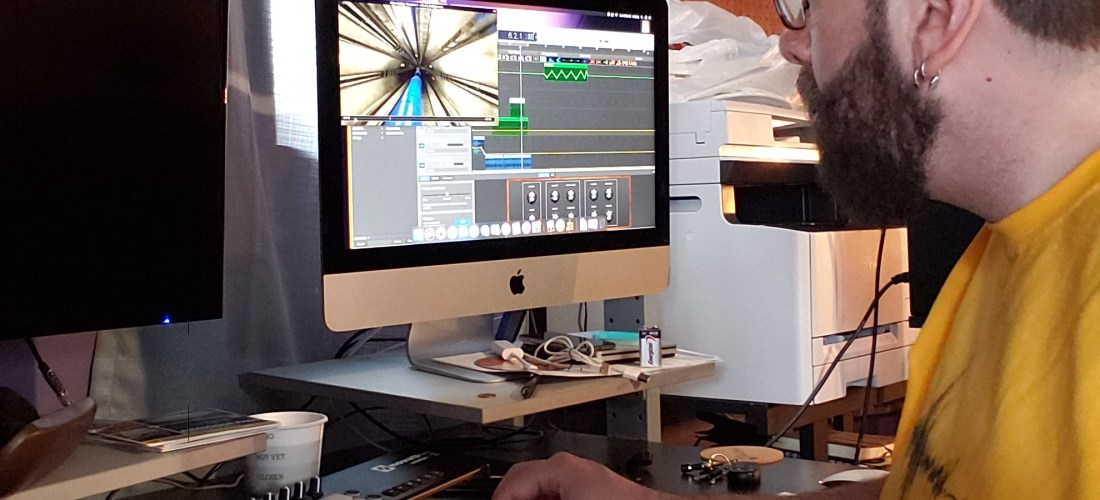
Recently, I had and assignment due in a music course that I am currently taking. The objective was to compose music to a short film that was provided to us. In this case, the visuals that were provided represent a computer animated sequence of an atom splitting. To work with the sequence of shots I created music that would support the narrative and theme of what was happening. The video can be seen here: https://youtu.be/Y48noA2pCj8.
In my example, I let the film dictate my choices for the style of music (sometimes it works the other way around with film and sound design). For instance, I chose an electronic based style of music. I timed various changes in the song structure to add more suspense until the actual climax of the atom splitting. Now, imagine this same video with the swing beat of a jazz tune, or the twang of a country song. Not only would it have an entirely different feel, it would not even make sense and it would work against the story of the short film.
My example is merely scratching the surface of the use of sound in film. The more elaborate the film is, the more sound elements must work with one another. Siu-Lan Tan (2018) describes it best by stating, “ It is important to remember that music does not act alone or play a solo role in film audio, but it is part of an ‘ensemble cast’ in the interplay of dialogue, music, and sound effects (p. 4). In my next few blogs I would like to focus on other directors, how they determine to use sound, and explore foley artistry (and its importance in cinema).
Brown, Andrew. (2015). Music Technology and Education: Amplifying Musicality. New York, NY: Routledge.
Siu-Lan Tan. (2018). Investigating Sound Design in Film: A Commentary on Kock and Louven. Empirical Musicology Review, 13(3/4), 149-154. Retrieved from https://search-ebscohost- com.proxy1.library.eiu.edu/login.aspx?direct=true&db=a9h&AN=136232159&site=ehost-live
 Trever's Blog