My last statement in my previous blog was, “music in many films appear to carry more weight with the attainment of popularity with audiences than the visual aspects.” I was referring to soundtracks in film that have well-known songs that are either popular at the time or songs that are already well-known classics. Using a soundtrack this way allows for a nostalgia to play a role with the audience, but it is also a form of capitalism. The film industry has employed music soundtracks in order to entice more viewers.
Batman Forever, Last Action Hero, and The Twilight Movies are movies that are often referred to as having an amazing soundtrack. Top notch bands are listed in the credits, but the storylines of these movies are average at best. Shumway (1999) points out, “The music in these films is meant to be not merely recognized, but often take the foreground and displace the image as the principal locus of attention” (p. 37). I admitted to enjoying some other subpar movies based on their soundtracks as well, but I never put much thought into the motives of this practice. After reading another Shumway (1999) quote, “…the music in these films secures a bond between consumer and product while also arousing a feeling of generational belonging in the audience” (p. 37). As I look back at my love for certain movies in the 90s and as a consumer…I see a lot of truth in Shumway’s statement.

Evidently the corporate gain works both ways with film and music advertising for one another. Music videos and MTV are fun to watch from time to time. However, seeing clips from a movie in a music video from a band I love annoys me. Smashing Pumpkins has a song that was featured in one of the Batman films. Something from the film is in sight almost the entire time: https://www.youtube.com/watch?v=FbP8q9oGEV4.. Grossberg (1993) says, “This functional definition of music videos is in fact rather common: music videos are often assumed to be merely promotional clips-new forms of advertising-for songs, albums, films, or products” (p. 186). I would venture to say it is a safe assumption that videos help feed consumerism.

Shumway (1999) explains that, “Tie-ins between films and soundtrack recordings have become so important that producers now routinely hire musical consultants to assemble a collection of songs that not only will make the movie more appealing, but will also lead to sales in music stores” (p. 37). I am not saying I am against the use of film and music promoting one another. Nor am I saying that ALL films with soundtracks are trying to lure in audiences. Many films, Boogie Nights for example, use music to enhance the story being told while others are more profit driven.
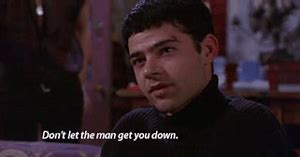
I try to find something interesting about a film that I watch. Very few films have a perfect balance in all areas. If music is what it has more to offer, so be it. Similarly (artistically speaking), special effects are taking over the dialogue in newer films that utilize computer graphic images. It really depends on what you want to get out of a movie. If you are watching movies as a form of escapism, then ultimately it does not matter if the music chosen overpowers the storyline. “Damn the Man,” a famous line from Empire Records, seems so appropriate and ironic in this case.
Grossman, L. (1993). The music Video Reader. Sound & Vision,
https://doi.org/10.4324/9780203993569
Shumway, D. (1999). Rock ‘n’ Roll Sound Tracks and the Production of Nostalgia. Cinema
Journal, 38(2). 36-51. http://www.jstor.org/stable/1225623
 Trever's Blog