My last statement in my previous blog was, “music in many films appear to carry more weight with the attainment of popularity with audiences than the visual aspects.” I was referring to soundtracks in film that have well-known songs that are either popular at the time or songs that are already well-known classics. Using a soundtrack this way allows for a nostalgia to play a role with the audience, but it is also a form of capitalism. The film industry has employed music soundtracks in order to entice more viewers.
             Batman Forever, Last Action Hero, and The Twilight Movies are movies that are often referred to as having an amazing soundtrack. Top notch bands are listed in the credits, but the storylines of these movies are average at best. Shumway (1999) points out, “The music in these films is meant to be not merely recognized, but often take the foreground and displace the image as the principal locus of attention” (p. 37). I admitted to enjoying some other subpar movies based on their soundtracks as well, but I never put much thought into the motives of this practice. After reading another Shumway (1999) quote, “…the music in these films secures a bond between consumer and product while also arousing a feeling of generational belonging in the audience” (p. 37). As I look back at my love for certain movies in the 90s and as a consumer…I see a lot of truth in Shumway’s statement.

              Evidently the corporate gain works both ways with film and music advertising for one another. Music videos and MTV are fun to watch from time to time. However, seeing clips from a movie in a music video from a band I love annoys me. Smashing Pumpkins has a song that was featured in one of the Batman films. Something from the film is in sight almost the entire time: https://www.youtube.com/watch?v=FbP8q9oGEV4.. Grossberg (1993) says, “This functional definition of music videos is in fact rather common: music videos are often assumed to be merely promotional clips-new forms of advertising-for songs, albums, films, or products” (p. 186). I would venture to say it is a safe assumption that videos help feed consumerism.

             Shumway (1999) explains that, “Tie-ins between films and soundtrack recordings have become so important that producers now routinely hire musical consultants to assemble a collection of songs that not only will make the movie more appealing, but will also lead to sales in music stores” (p. 37). I am not saying I am against the use of film and music promoting one another. Nor am I saying that ALL films with soundtracks are trying to lure in audiences. Many films, Boogie Nights for example, use music to enhance the story being told while others are more profit driven.
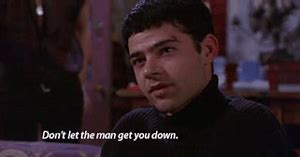
            I try to find something interesting about a film that I watch. Very few films have a perfect balance in all areas. If music is what it has more to offer, so be it. Similarly (artistically speaking), special effects are taking over the dialogue in newer films that utilize computer graphic images. It really depends on what you want to get out of a movie. If you are watching movies as a form of escapism, then ultimately it does not matter if the music chosen overpowers the storyline. “Damn the Man,” a famous line from Empire Records, seems so appropriate and ironic in this case.
Grossman, L. (1993). The music Video Reader. Sound & Vision,  
https://doi.org/10.4324/9780203993569

Shumway, D. (1999). Rock ‘n’ Roll Sound Tracks and the Production of Nostalgia. Cinema
             Journal,
38(2). 36-51. http://www.jstor.org/stable/1225623        
             Scoring a film allows the composer the freedom to write music that accompanies the scenes they are given.  Movie soundtracks are handled differently. Not only does the music have to be chosen to fit the scene, the director may have to limit his vision to the context of the chosen song. The correct song choices should create an atmosphere, bring forth a mood, and/or elements of nostalgia.
             Ekman (1999) highlights that the most common and basic human emotions are: happiness, sadness, fear, disgust, anger, and surprise (p. 45). Tapping into one or more of those basic human emotions is the goal in any movie. Although it is a challenge, a director and sound designer(s) need to blend the chosen music for their soundtrack in a cohesive manner with a film. If this is done successfully, the film can be more memorable for the audience by having music they can relate to.              
               In my previous blog I discussed how George Lucas chose to have a score written for Star Wars. With another one of his films, American Graffiti, he opted to have a soundtrack selected for this project. When you compare the plots of these two films it is understandable on why he might have done this. Star Wars presented a slew of unorthodox characters and living their lives on other planets in an outer space drama. Dramatic orchestration captures the grandness of the story.
             On the other end of the spectrum you have American Graffiti. This film is about the lives of some American teenagers and some of the experiences they have in one night all while incorporating music from the fifties. Sider (2003) elaborates with, “Sound changes the image…music and sound not only imbues the image with emotional or cultural resonance, it also guides the viewer’s attention” (p.10). American Graffiti was a huge success. The popular music in the film is a such a huge part of American culture. The music is nostalgic to such a huge population and it is a big reason why it was such a successful film.
             Clearly, stylistic choices must be done tastefully to work with the storyline. Boltz (2001) states, “In addition to effects upon perceptual judgements, there is evidence that music can influence the remembering of filmed events” (p. 429). Certain movies like Empire Records, Chasing Amy, Fear, Singles, and So I Married an Axe Murderer have bands that I listened to in my impressionable youth. Well, I still listen to those bands and I will watch those movies over and over just to hear those soundtracks! However, even when I am not watching those movies and I hear a song from a film I enjoyed…I am immediately transported to whatever scene the music was utilized in. Also, the storylines and visuals of the films I just listed are not the best or the worst. However, the music in many films appear to carry more weight with the attainment of popularity with audiences than the visual aspects.

Boltz, M. (2001). Musical Soundtracks as a Schematic Influence on the Cognitive Processing of Filmed Events. Music Perception: An Interdisciplinary Journal,18(4), 427-454. doi:10.1525/mp.2001.18.4.427

Ekman, P. (1999), ‘Basic emotions’, in T. Dalgleish and M. Power (eds), Handbook of Cognition
         and Emotion
, 45–60, New York: Wiley & Sons Ltd.

Sider, L. (2003). If you wish to see, listen. The role of sound design. Journal of Media Practice,
         4(1). 5-15. https://doi.org/10.1386/jmpr.4.1.5/0

The Sounds of Star Wars

               When I think of a great example of a movie with perfect film score, I immediately think of Star Wars. The Star Wars franchise, created and directed by George Lucas, utilized the composer John Williams. Their combined efforts created a masterpiece with this film franchise both visually and audibly. Today’s films are putting emphasis on computer animated graphics for intense action sequences and setting/backdrops; this lack of focus on sound design and musical scoring has taken away certain charismatic aspects of modern film that Star Wars was able to tap in to. Weinman (2015) elaborates, “One reason the Star Wars music has such a nostalgic glow is that it sounds different from most of today’s film music. Today’s movies, even the blockbusters, don’t usually have iconic theme music, or scores that we’re supposed to walk away humming” (p. 50).

                As unfortunate as it may seem, I do know people that have not seen any Star Wars films. However, they do know the music and the sound effects used in the films! When most people hear this: https://www.youtube.com/watch?v=R97xPTV6P6g, an image of Darth Vader has most likely popped up in their mind. John Williams is clearly a master at leitmotif; another one of Williams’ recognizable themes: https://www.youtube.com/watch?v=llKVNLdvoo8. Although the last example is from another film, his creation of melodies for leitmotif creates a visual for certain characters and actions in films even if we are only hearing the music.

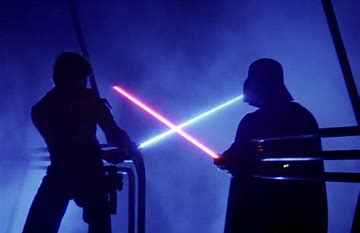
              Not only is the music iconic in Star Wars, so is the sound design and effects created for this film. Ben Burtt deserves just as much notoriety as George Lucas and John Williams. The first Star Wars film was created at a time without the convenience of creating sounds with the technology we have today. As a foley artist (a person that incorporates sound in post-production), Ben Burtt had to create sounds to concepts that the audience had never heard of before…such as the light saber: https://www.youtube.com/watch?v=__sDEWIjQ_g.   

               Combing the imagination and vision of George Lucas with the music/sound talents of John Williams and Ben Burtt you get a nostalgic film(s) such as Star Wars and its franchise. In an interview, Dove (2005) shares Lucas’ insight, “I hold firm to the belief that the sound in a movie is 50 percent of the moviegoing experience and it is the primary reason I invest heavily in the auditory elements upfront” (p. 2). Founder of Skywalker Ranch (a sound design and post production mixing facility) and THX surround sound, George Lucas’ has set a high standard for audio in films.

Dove, K. (2005). Learning From George. Computer Graphics World, 28(9), 2. Retrieved from https://search-ebscohost-com.proxy1.library.eiu.edu/login.aspx?direct=true&db=a9h&AN=18329384&site=ehost-live

Weinman, J.J. (2015). Da-da dun-dun-dun da-da. Maclean’s, 128(45), 50-52. Retrieved from https://search-ebscohost-com.proxy1.library.eiu.edu/login.aspx?direct=true&db=a9hAN=
     110724636&site=ehost-live

Scene & Heard

               Sound is often taken for granted in the art of film. Yet, even in the genre of silent films, music accompanies the visuals. Whether it is the dialogue between actors/actresses, the music, or the sound effects in the background, the choices made in sound design influence how an audience perceives a film.
               Loudness, pitch, and timbre are fundamentals of sound and these principals of sound need to be taken into consideration to make use of audio appropriately in a film. Loudness relates to a sound’s amplitude; proper use of loudness helps the audience perceive distance within the film. Pitch is a certain frequency a sound makes; pitch is important to help the audience discern a sound. Timbre is simply how something sounds; most people can decipher the sound of a piano versus the sound of a violin or the sound of footsteps versus someone clapping their hands. Timbre creates texture and provides more realism in film by replicating how we recognize sound in real life situations.
               Brown (2015) describes sound design in film as the use of foley effects (various sounds that complement the action seen, such as: gunshots, the sound of footsteps, etc…), atmospheric soundscapes, the music utilized, and the tastefulness of all these sounds combined (p. 95). Proper sound design in film almost creates an experiential realism for the viewer. Complementing a scene is the key; the sound, whether it is sound effects, the dialogue, or the music, should always work with the scene and not against it.
               Recently, I had and assignment due in a music course that I am currently taking. The objective was to compose music to a short film that was provided to us. In this case, the visuals that were provided represent a computer animated sequence of an atom splitting. To work with the sequence of shots I created music that would support the narrative and theme of what was happening. The video can be seen here: https://youtu.be/Y48noA2pCj8.
                In my example, I let the film dictate my choices for the style of music (sometimes it works the other way around with film and sound design). For instance, I chose an electronic based style of music. I timed various changes in the song structure to add more suspense until the actual climax of the atom splitting. Now, imagine this same video with the swing beat of a jazz tune, or the twang of a country song. Not only would it have an entirely different feel, it would not even make sense and it would work against the story of the short film.
                My example is merely scratching the surface of the use of sound in film. The more elaborate the film is, the more sound elements must work with one another. Siu-Lan Tan (2018) describes it best by stating, “ It is important to remember that music does not act alone or play a solo role in film audio, but it is part of an ‘ensemble cast’ in the interplay of dialogue, music, and sound effects (p. 4). In my next few blogs I would like to focus on other directors, how they determine to use sound, and explore foley artistry (and its importance in cinema).

Brown, Andrew. (2015). Music Technology and Education: Amplifying Musicality. New York, NY: Routledge.

Siu-Lan Tan. (2018). Investigating Sound Design in Film: A Commentary on Kock and Louven.   Empirical Musicology Review, 13(3/4), 149-154. Retrieved from https://search-ebscohost- com.proxy1.library.eiu.edu/login.aspx?direct=true&db=a9h&AN=136232159&site=ehost-live